Bolivar's Carnegie library opened to the public on March 13, 1915. The building at 120 E. Jackson began with a grant, donated land and months of local planning. It later became home to the Polk County Genealogical Society.
The library's history is more than a building date. It shows how a town worked to create a place for reading, then found a new use for it when public library services moved.
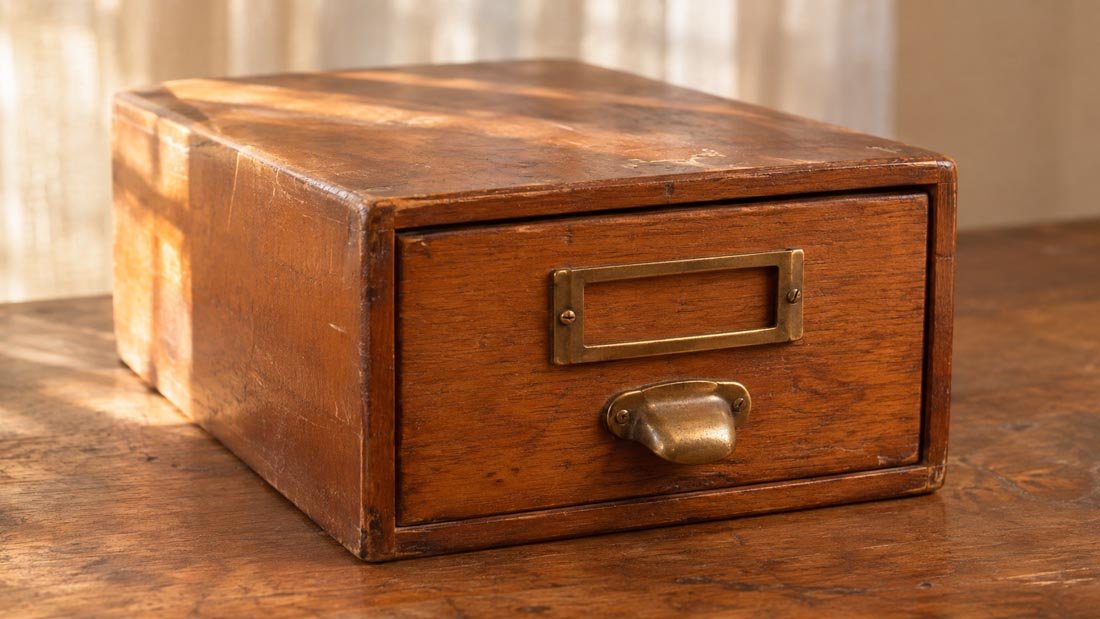
A generic card-catalog drawer illustrates the library story. It is not furniture documented in the Bolivar library.
A grant needed local support
The National Register nomination for the Bolivar Public Library traces the project through letters, local records and newspaper accounts. Its brief timeline begins with an application for a Carnegie library grant on August 4, 1913.
The same record lists a land gift in April 1914 from T. H. B. Dunnegan and his wife, Ella C. Dunnegan. The gift provided a library site on the courthouse square. Dunnegan also led the library board.
The Carnegie grant was $8,000. Local work turned that support into a finished library. The nomination names Springfield architect James Heckenlively as its designer and records the March 1915 opening.
A gift of money and a gift of land were separate parts of the project. Keeping them separate helps explain how the building came about.
The building changed with its work
The nomination's timeline records new front steps in 1926. It also places a major change in 1951, when the Bolivar library board voted to become part of the Polk County Library.
Public library operations left the Jackson Street building in 2000. The genealogical society moved into it in 2001, according to that same timeline. Those dates mark different uses of one building, rather than the end of its connection to books and research.
A new chapter for an old library
The genealogical society's account of its library building explains the later effort to gain historic recognition. The society began that process in November 2001, with Lou Kemp coordinating the work. The building joined the National Register of Historic Places on July 17, 2003.
That account also describes members finding library stories while searching old newspapers. Records gathered for one purpose helped tell the story of the place that would hold them.
If you want to research your own family there, our guide to the Polk County Genealogical Society covers where to begin. The building's early history gives that visit another point of interest: a local reading place opened in 1915 now helps people trace the town's past.